Home › First aid guides › How to Treat Minor Cuts and Scrapes at Home
First aid guide
How to Treat Minor Cuts and Scrapes at Home
A calm, step-by-step routine for cleaning a minor cut or scrape, when an antibiotic ointment fits in, how triple antibiotic and bacitracin differ, and the signs that mean it is time to call a doctor.
This is general information, not medical advice. Always read and follow the Drug Facts label on the product you use, and ask a doctor or pharmacist about your situation.
A skinned knee on the sidewalk, a kitchen-knife nick, a scrape from a garden trellis — most cuts and scrapes are minor and heal fine at home with a little basic care. The routine below is what school nurses, workplace first aid programs, and family doctors have taught for decades. It is simple on purpose.
First, decide whether it is actually minor
A "minor" cut or scrape is shallow, bleeding stops on its own or with a few minutes of gentle pressure, and the edges of the skin stay together. Anything beyond that deserves a professional look. Seek medical care right away if:
- Bleeding does not stop after 10 minutes of firm, steady pressure.
- The wound is deep, gaping, or you can see fat, muscle, or bone.
- It was caused by an animal or human bite, or a dirty or rusty object.
- There is something embedded in the wound that you cannot rinse out.
- The cut is on the face, over a joint, or is longer than about half an inch and will not stay closed.
- The person has not had a tetanus shot in the last 5 to 10 years, especially for a puncture wound.
If none of those apply, carry on.
Step 1: Wash your hands
Before you touch the wound, wash your own hands with soap and water, or use hand sanitizer if soap is not available. Hands are one of the most common ways germs reach a wound while it is being treated.
Step 2: Stop the bleeding
Press a clean cloth, gauze pad, or paper towel gently but firmly against the wound. Hold it there for several minutes without peeking. Lifting the cloth to check restarts the clotting process. Elevating the injured area above the heart, if practical, helps too.
Step 3: Rinse the wound
Hold the cut or scrape under cool, clean running water for a few minutes. That alone flushes out most dirt and debris. If grit is stuck in a scrape, use a clean pair of tweezers wiped with rubbing alcohol to lift it out. Wash the skin around the wound with mild soap, but try to keep soap out of the wound itself, since it can irritate the raw tissue.
Skip hydrogen peroxide and rubbing alcohol on the wound. They sting, and they can damage the healthy tissue that is trying to repair the injury. Water is enough.
Step 4: Pat dry and apply a first aid antibiotic ointment
Gently pat the area dry with a clean towel. Then apply a thin layer of a first aid antibiotic ointment. The Drug Facts label on these products describes the use as "first aid to help prevent infection in minor cuts, scrapes, and burns," and the directions call for a small amount — about the size of a fingertip — applied to the area one to three times daily.
Ointments do two useful things here. They help prevent infection, and they keep the surface of the wound from drying out and forming a tight, cracked scab that catches on clothing. A moist wound bed is generally more comfortable while it heals.
Triple antibiotic vs. bacitracin: which one?
Both are over-the-counter first aid antibiotics, and both carry the same basic label use. The difference is the number of active ingredients.
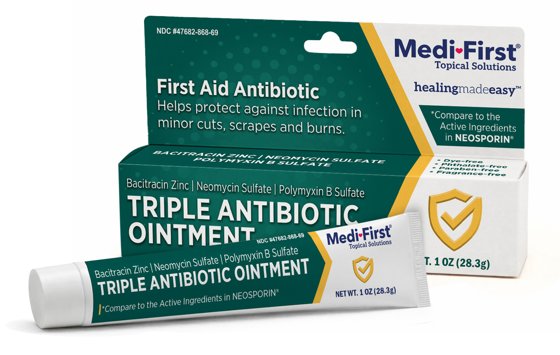
- Triple antibiotic ointment combines three antibiotics: bacitracin zinc, neomycin sulfate, and polymyxin B sulfate. This is the same trio found in Neosporin®, and it is the most familiar choice for a general-purpose first aid kit.
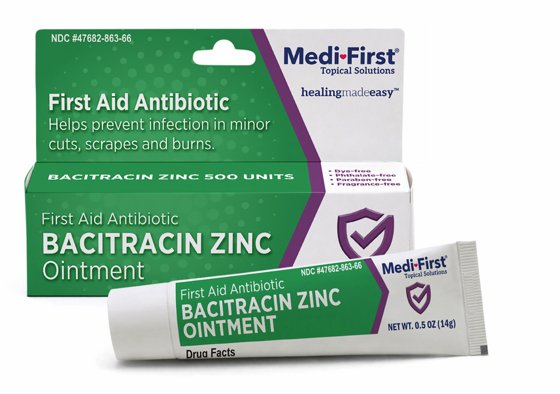
- Bacitracin zinc ointment contains a single antibiotic, bacitracin zinc, at 500 units per gram. Some people prefer a single-ingredient ointment, and it is a common pick for anyone who has reacted to neomycin in the past. If you have ever developed a red, itchy rash around a bandage after using a triple antibiotic, mention it to your pharmacist; a bacitracin-only product may be the better fit.
Either way, read the Warnings on the Drug Facts panel. These products are for external use only, should not be used in the eyes or over large areas of the body, and the label tells you to stop use and ask a doctor if a rash or other allergic reaction develops, or if the condition persists or gets worse.
Medi-First® Triple Antibiotic Ointment and Bacitracin Zinc 500 Units Ointment are both dye-free, phthalate-free, paraben-free, and fragrance-free, and come in 0.5 oz and 1 oz resealable tubes sized for a first aid kit, a backpack, or a glove box.
Step 5: Cover it
Cover the wound with a sterile adhesive bandage or gauze and tape. A cover keeps the area clean, keeps the ointment in place, and protects the wound from bumps. Small scrapes that are not likely to get dirty or rubbed can be left uncovered once they stop weeping.
Step 6: Change the dressing daily
Change the bandage once a day, or sooner if it gets wet or dirty. Each time, rinse gently, look at the wound, reapply a thin layer of ointment, and put on a fresh bandage. Most minor cuts and scrapes close within a few days and are well on their way in a week.
Watch for signs of infection
Check the wound every time you change the dressing. Call a doctor if you notice:
- Increasing redness spreading out from the wound, or red streaks leading away from it.
- Swelling, warmth, or pain that gets worse instead of better after the first day or two.
- Pus or cloudy drainage.
- A fever.
- No sign of healing after about a week.
Build the habit: keep a kit stocked
The reason a scraped knee turns into a scramble is usually that the supplies are scattered. A small box with adhesive bandages in a few sizes, sterile gauze, tape, tweezers, and a tube of first aid antibiotic ointment covers nearly every minor cut or scrape a household sees. Keep one at home and one in the car, and check expiration dates twice a year.
This is general information, not medical advice. Read and follow the Drug Facts label on any product you use. If you are unsure whether a wound is minor, ask a doctor or pharmacist.
Products mentioned
Stock the kit
First Aid Antibiotics
Triple Antibiotic Ointment
Bacitracin Zinc | Neomycin Sulfate | Polymyxin B Sulfate
Compare to Neosporin®*
1 oz · 6-pack