
Home › First aid guides › Tolnaftate vs. Clotrimazole vs. Miconazole: Choosing an Antifungal
First aid guide
Tolnaftate vs. Clotrimazole vs. Miconazole: Choosing an Antifungal
The three over-the-counter antifungal creams look alike on the shelf. Here is how tolnaftate, clotrimazole, and miconazole nitrate differ, what each label says, and how to pick one for athlete's foot, jock itch, or ringworm.
This is general information, not medical advice. Always read and follow the Drug Facts label on the product you use, and ask a doctor or pharmacist about your situation.
Athlete's foot, jock itch, and ringworm are all caused by the same family of fungi, which is why one shelf at the pharmacy can hold three different creams that all claim to treat the same three conditions. Tolnaftate, clotrimazole, and miconazole nitrate are the three most common over-the-counter antifungal active ingredients, and each is the active in a national brand you already know. Choosing among them is less about which is "strongest" and more about the details on the label.
The conditions, briefly
- Athlete's foot (tinea pedis) usually starts between the toes: itching, burning, cracking, and scaling skin. It thrives in warm, damp shoes.
- Jock itch (tinea cruris) is the same kind of infection in the groin and inner thighs, typically a red, itchy rash with a defined edge.
- Ringworm (tinea corporis) has nothing to do with worms. It is a ring-shaped, scaly patch on the body, often with a clearer center.
All three are common, contagious through contact and shared surfaces, and usually respond well to an over-the-counter topical antifungal used exactly as directed.
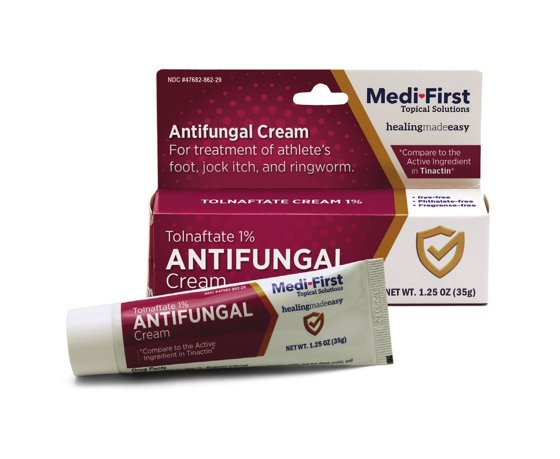
Tolnaftate 1%
Tolnaftate is the active ingredient in Tinactin®. Its Drug Facts label covers treatment of most athlete's foot, jock itch, and ringworm, and relief of the itching, burning, and cracking that come with them. It is a non-azole antifungal, which makes it a natural alternative for someone who has already finished a course of an azole cream without improvement.
Tolnaftate creams are typically applied twice daily. The label directions for athlete's foot and ringworm run four weeks, and for jock itch two weeks. Medi-First® Tolnaftate 1% Antifungal Cream is dye-free, phthalate-free, and fragrance-free, in 0.5 oz and 1.25 oz tubes.
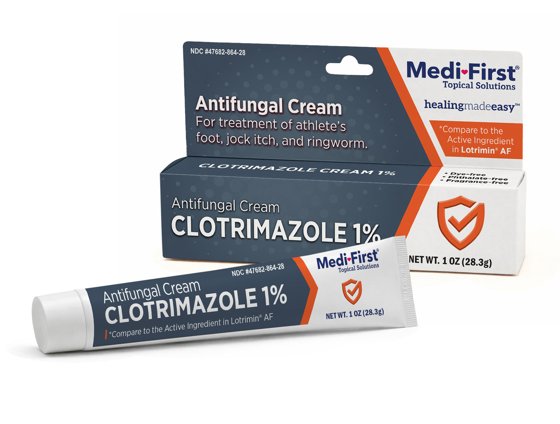
Clotrimazole 1%
Clotrimazole is the active ingredient in Lotrimin® AF cream and belongs to the azole family of antifungals. It is the only one of the three whose Medi-First® label uses the word "cures": clotrimazole 1% is labeled to cure most athlete's foot, jock itch, and ringworm, and to relieve the itching, burning, cracking, scaling, and discomfort that come with them.
Clotrimazole is generally applied twice a day. The labeled duration is four weeks for athlete's foot and ringworm and two weeks for jock itch. It is a familiar, well-studied choice and is often what a pharmacist reaches for when someone simply asks for "athlete's foot cream." Medi-First Clotrimazole 1% Antifungal Cream is dye-free, phthalate-free, and fragrance-free, in a 1 oz tube.
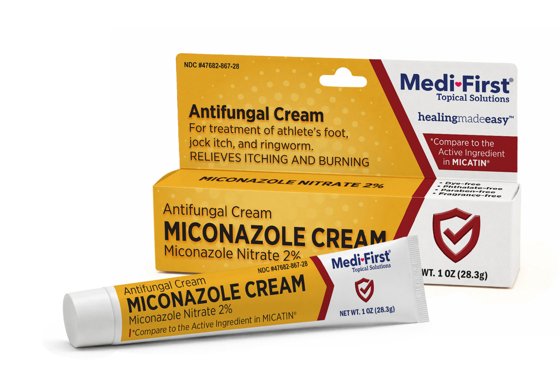
Miconazole nitrate 2%
Miconazole nitrate is the active ingredient in Micatin® and is also an azole. Its label covers treatment of most athlete's foot, jock itch, and ringworm, and relief of the itching, scaling, burning, and discomfort that accompany them.
Miconazole creams are typically applied twice daily, four weeks for athlete's foot and ringworm and two weeks for jock itch. Medi-First Miconazole Nitrate 2% Antifungal Cream is dye-free, paraben-free, phthalate-free, and fragrance-free, in a 1 oz tube.
So which one?
A practical way to decide:
- You want the label language "cures most." That is clotrimazole 1%, the classic azole, labeled for all three conditions.
- You want a clinically proven azole alternative. Miconazole nitrate 2% is labeled for the same three conditions and for relief of itching, scaling, burning, and discomfort.
- One did not work for you before. Tolnaftate and the azoles work in different ways. If you finished a full course of one without improvement, a doctor may suggest the other class, or may want to check whether the rash is fungal at all.
Whichever you choose, the two mistakes that undo most antifungal treatment are the same: stopping as soon as it looks better, and skipping applications. Fungi are stubborn. The label durations exist because the infection is still there after the itching stops.
How to get the most out of any antifungal cream
- Wash and thoroughly dry the area before applying. Fungus loves moisture; a towel is part of the treatment.
- Apply a thin layer over the affected skin and about an inch beyond the visible edge.
- Wash your hands after applying to avoid spreading the infection.
- For athlete's foot, wear clean cotton or moisture-wicking socks, change them daily, alternate shoes so each pair dries out, and wear sandals in shared showers.
- For jock itch, choose loose, breathable underwear and change out of sweaty clothes promptly.
- Do not share towels, and wash bedding and socks in hot water while you are treating an infection.
When to see a doctor
Over-the-counter antifungals are meant for uncomplicated infections. Check with a doctor if:
- There is no improvement after the labeled treatment period (two weeks for jock itch, four weeks for athlete's foot or ringworm).
- The rash is on the scalp or in the nails; those usually need prescription treatment.
- The skin is cracked, bleeding, or oozing, or you have diabetes or a weakened immune system.
- The rash keeps returning despite treatment.
- Irritation develops from the cream itself. Stop use and ask a doctor, as the label directs.
Medi-First's antifungal lineup at a glance
| Active | Compare to | Sizes |
|---|---|---|
| Tolnaftate 1% | Tinactin® | 0.5 oz, 1.25 oz |
| Clotrimazole 1% | Lotrimin® AF | 1 oz |
| Miconazole nitrate 2% | Micatin® | 1 oz |
Compare-to statements refer to active ingredients only; Medi-First products are not manufactured or distributed by the owners of those trademarks.
This is general information, not medical advice. Read and follow the Drug Facts label on the product you use, and ask a doctor or pharmacist if you are unsure whether a rash is fungal.
Products mentioned
Stock the kit
Antifungal Care
Clotrimazole 1% Antifungal Cream
Clotrimazole 1%
Compare to Lotrimin® AF*
1 oz · 4-pack or 6-pack
Antifungal Care
Miconazole Nitrate 2% Antifungal Cream
Miconazole Nitrate 2%
Compare to Micatin®*
1 oz · 4-pack or 6-pack